
In the past, weeding was a grueling test of physical endurance. Armed with only a hand scythe or a heavy brushcutter, you would spend all day hunched over under a scorching sun, clearing the land inch by inch. Returning home at the end of the day meant a sore back, aching muscles, drenched in sweat, and hands covered in calluses. It was slow, exhausting, and carried the constant risk of heatstroke and injury.
Today, however, this reality is being completely rewritten.
The Era of Hands-Free, Smart Mowing Has Arrived
Smart mowing robots are transforming weeding from a backbreaking chore into an automated, worry-free service.
There is no need to carry heavy machinery, hunch over with a scythe, or endure the blistering sun. All you need to do is:
- Set the working boundary and cutting height;
- Press the start button;
- And then… sit back in the shade, enjoy a cup of tea, or check your phone.
The robot navigates, cuts, plans its path, and avoids obstacles entirely on its own. In no time, you will return to find a clean, neat lawn or cleared field.
You enjoy the results, while the machine handles the hard work.
Real-World Scenarios: People Relaxing, Machines Working
In our field tests across various locations, we regularly witness these contrasting scenes:
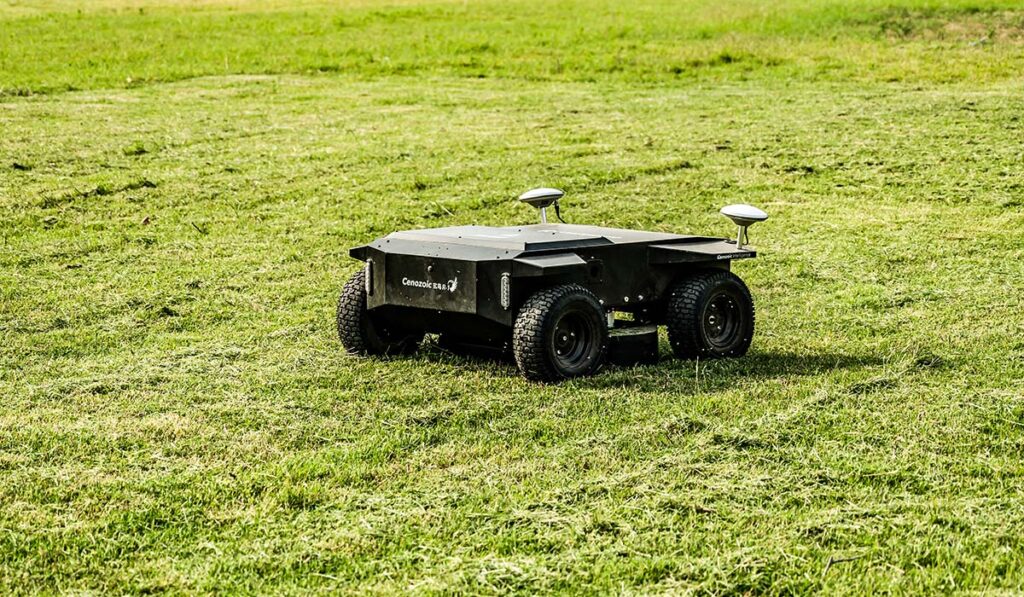
Scenario 1: Residential Lawns
- Before: Family members took turns pushing a heavy lawnmower across the yard, gasping for breath in the summer heat, completely exhausted after a couple of hours.
- Now: The homeowner sips coffee on the porch while the robot moves at a steady pace along a pre-programmed S-shaped grid pattern. The grass is cut to a uniform height, and the machine automatically returns to its charging dock after two hours—all with zero human intervention.
Scenario 2: Orchard Rows
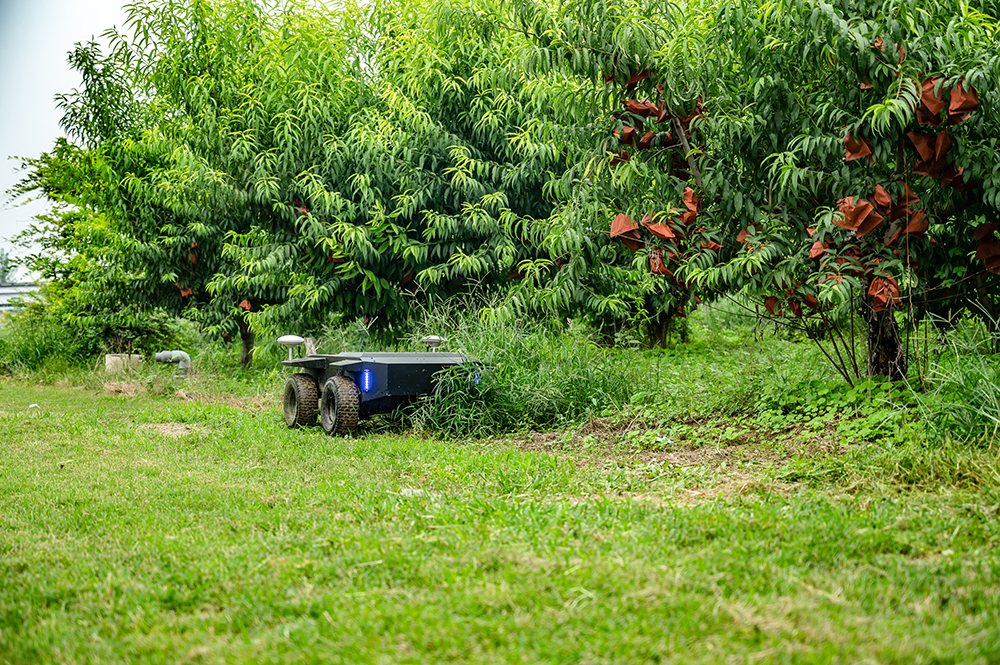
- Before: Growers carried a noisy, vibrating 15-lb brushcutter, navigating between fruit trees. Breathing in exhaust fumes all day left their ears ringing and bodies exhausted.
- Now: Growers stand in the shade, monitoring progress on a tablet. The robot automatically maneuvers between trees, avoids obstacles, trims close to the edges, and finishes the job without the grower ever stepping into the field.
Scenario 3: River Embankments and Slopes
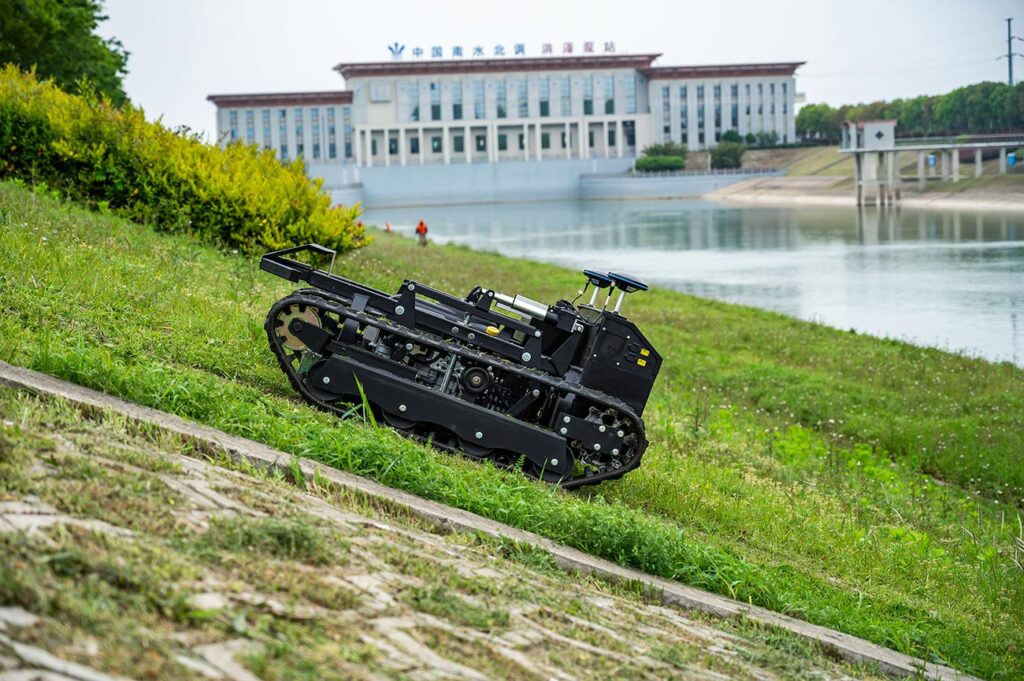
- Before: Maintenance crews carried heavy machinery up steep slopes, constantly slipping and risking dangerous falls in a high-hazard environment.
- Now: Operators safely monitor the operation from flat ground at the top of the slope, while the robot securely grips the incline, mowing steadily and safely. The safety improvement is night and day.
The Technology Behind the Scenes: How Does Unmanned Mowing Work?
While “sipping tea while the machine works” sounds like science fiction, development teams like Suzhou New Coordinate Intelligent Equipment Co., Ltd. have turned this into reality. This level of automation relies on three core pillars:
- Autonomous Navigation (No Manual Steering Required)
Utilizing RTK-GNSS sub-inch (centimeter-level) positioning paired with vision and LiDAR sensors, the robot precisely knows its location, its path, and how to bypass obstacles. There is no need for an operator to guide or steer it. - Intelligent Path Planning (No Manual Supervision Needed)
With built-in path-planning algorithms, the machine automatically generates the most efficient route. This eliminates missed spots and redundant overlaps, resulting in a cleaner, more efficient cut than manual estimation. - Active Obstacle Avoidance (No Constant Monitoring Required)
When encountering rocks, trees, or flowerbeds, the robot automatically slows down and steers around them. Operators no longer need to be on constant alert to prevent collisions.
Together, these three innovations deliver a true “set-and-forget” unmanned experience.
Technology Changing Lives: Beyond the Buzzwords
When first hearing about “smart mowing robots,” many wonder: Is this reliable, or is it just a gimmick?
But when you witness:
- A senior operator no longer needing to carry a heavy brushcutter up steep inclines;
- Orchard owners no longer struggling to find seasonal labor for weeding;
- Municipal maintenance crews eliminating safety incidents caused by working in extreme summer heat;
- A neglected, overgrown embankment transformed into a neat, clean green space in just a few days…
You realize that technology modernizing outdoor maintenance is not just a slogan—it is a practical reality happening right now.
Conclusion
From a hand scythe to an autonomous robot, from exhausting manual labor to relaxing in the shade—agriculture and landscaping, some of our oldest industries, are undergoing a quiet, powerful revolution.
By delegating the most strenuous physical tasks to intelligent machinery, humans can focus on higher-value decision-making and management. This is the true promise of technology.
The future is here. Are you ready to step back and let technology handle the mowing?