
As the global energy transition accelerates, solar power continues to expand as an important source of clean energy. Alongside the growth of solar installations, the operation and maintenance of solar farms have become increasingly important.
Vegetation management is one of the routine tasks that solar farm operators need to address. Uncontrolled weed growth can affect site accessibility, obstruct inspection routes, and create additional fire hazards during dry seasons. In certain conditions, vegetation may also cast shadows on solar panels.
Maintaining large solar farms can be particularly challenging when the site is located on hillsides, uneven ground, or other difficult terrain. Manual mowing requires considerable labor, while conventional wheeled mowing equipment may have limitations when operating on slopes and uneven surfaces.
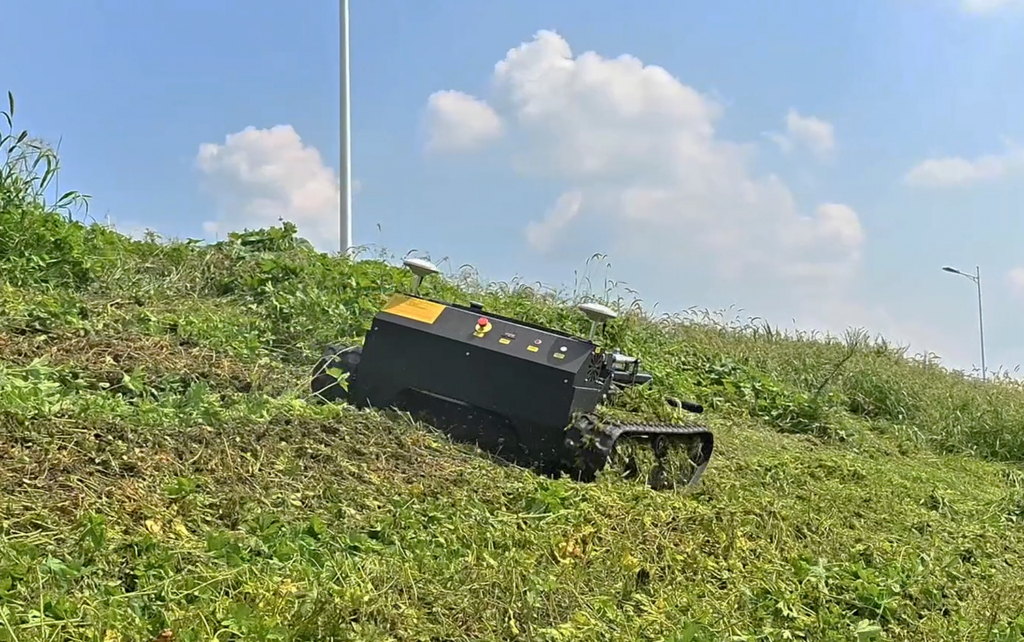
To address the needs of demanding outdoor mowing applications, Suzhou Xinzuobiao Intelligent Equipment Co.,Ltd offers the XuanNiao T1 tracked hybrid smart mower. Featuring a tracked chassis, a hybrid power system, and intelligent navigation and remote-control capabilities, the T1 provides a mechanized mowing option for solar farms and other large outdoor areas.
1. Key Challenges of Vegetation Management in Solar Farms
Solar farms often cover extensive areas and contain closely arranged infrastructure. Their terrain and operating conditions can vary significantly from one project to another.
1.1 Large Areas and Repetitive Maintenance Work
Solar farms require regular vegetation management around panel arrays, equipment areas, access roads, and site boundaries.
As weeds grow at different rates throughout the year, maintenance teams need to organize mowing operations on a recurring basis. Relying entirely on manual labor can increase workload, extend maintenance cycles, and make workforce planning more difficult.
1.2 Uneven Ground and Sloping Terrain
Some solar installations are built on hills, slopes, and uneven land. These sites may include loose soil, gravel, changing gradients, and narrow access routes.
Conventional wheeled mowers may face limitations in traction and ground adaptability under such conditions. Equipment selection therefore needs to consider slope capability, ground contact, stability, and site accessibility.
1.3 Safety Around Solar Infrastructure
Solar farms contain photovoltaic modules, mounting structures, cables, inverters, and other electrical equipment.
Mowing equipment must operate with appropriate clearance from these facilities. Site assessment, route planning, operator supervision, and clearly defined working boundaries are essential to reducing the risk of accidental contact or equipment damage.
1.4 Continuous and Seasonal Vegetation Management
Weed growth is influenced by rainfall, temperature, soil conditions, and seasonal changes. Solar farm operators therefore need a practical approach to recurring vegetation maintenance rather than relying on occasional mowing.
Mechanized mowing equipment can help maintenance teams establish more consistent operating procedures and reduce repetitive manual work.
2. XuanNiao T1: A Tracked Hybrid Smart Mower for Challenging Outdoor Applications
The XuanNiao T1 is a commercial tracked hybrid smart mower developed by Suzhou Xinzuobiao Intelligent Equipment Co.,Ltd.
Designed for demanding outdoor mowing applications, it combines a tracked travel system, hybrid power, intelligent navigation, and remote-control operation. These features make it a potential equipment choice for suitable solar farm environments, particularly where terrain conditions require enhanced ground adaptability.
2.1 Hybrid Power for Outdoor Mowing Operations
The XuanNiao T1 adopts a hybrid power configuration that combines an engine with an electric drive system to support machine operation and mowing tasks.
This configuration provides an alternative for commercial applications where operating duration and power requirements need to be considered together.
The T1 is available in different engine configurations, including single-cylinder and twin-cylinder versions. Customers can select the appropriate configuration according to their operating requirements and project conditions.
2.2 Tracked Chassis for Improved Terrain Adaptability
Terrain adaptability is an important consideration when selecting mowing equipment for hillside and uneven solar farm sites.
The XuanNiao T1 uses a tracked chassis. Compared with conventional wheeled designs, tracks provide a larger ground contact area, helping improve traction and mobility on suitable uneven surfaces.
The T1 has a maximum climbing capability of up to 40°, making it suitable for certain sloping outdoor applications.
Actual operating suitability depends on factors such as slope material, ground traction, moisture, surface stability, and site safety conditions. A site assessment is recommended before deployment.
2.3 Intelligent Navigation and Remote-Control Operation
The XuanNiao T1 supports intelligent navigation and remote-control operation, with the operating method selected according to the equipment configuration and project requirements.
For suitable sites, intelligent navigation can be used in conjunction with site mapping and mowing-area planning. Remote control provides operators with an additional way to manage the machine and make adjustments when required.
The equipment also supports remote-control and alarm functions, helping operators monitor and manage machine operation.
Before use in a solar farm, the working area, access routes, and safety boundaries should be assessed and verified according to the actual site layout.
2.4 Adjustable Cutting Height for Different Vegetation Conditions
Vegetation types and maintenance requirements vary across solar farms.
The XuanNiao T1 features an adjustable mowing deck with a cutting-height range of 2–15 cm. Operators can select an appropriate cutting height according to vegetation conditions and site management requirements.
With a 90 cm cutting width, the machine is designed for mechanized mowing in large outdoor areas.
Appropriate cutting-height settings and regular mowing schedules can help control vegetation growth and support routine site maintenance.
3. How the XuanNiao T1 Supports Solar Farm Maintenance
3.1 Improving Mowing Efficiency
Large solar farms require recurring mowing across extensive areas. Mechanized equipment can reduce repetitive manual work and help maintenance teams organize operations more efficiently.
With its tracked chassis and 90 cm cutting width, the XuanNiao T1 provides a practical option for suitable large-area outdoor mowing applications.
Actual productivity depends on vegetation density, terrain, operating routes, and working conditions.
3.2 Adapting to Slopes and Uneven Ground
In hillside and mountainous solar projects, terrain can determine which areas are accessible to mowing equipment.
The T1’s tracked travel system and climbing capability of up to 40° provide an option for certain sloping applications where the ground conditions and safety requirements are suitable.
3.3 Reducing the Need for Manual Work in Difficult Areas
Manual mowing on steep or uneven terrain can involve high physical demands and additional safety considerations.
Using mechanized mowing equipment can reduce the frequency with which workers need to enter certain difficult areas. When combined with remote operation and appropriate site management, this can help improve working conditions for maintenance personnel.
3.4 Supporting Regular Vegetation Management
Vegetation management is an ongoing task for solar farm operators.
The XuanNiao T1 can be incorporated into scheduled mowing operations to help maintenance teams establish a more consistent mechanized workflow. Mowing frequency and operating routes should be determined according to local vegetation growth and site conditions.
It is important to note that mowing primarily helps control vegetation height. Solar power generation is also affected by sunlight, panel cleanliness, system design, and equipment operating conditions. The impact of mowing on energy output should therefore be evaluated based on the specific project.
4. Suitable Solar Farm Applications
4.1 Mountainous Solar Farms
Mountainous solar projects often feature steep slopes, uneven surfaces, and complicated access routes.
The XuanNiao T1’s tracked chassis and climbing capability make it a potential mowing solution for suitable hillside areas, subject to site assessment and operating safety requirements.
4.2 Hilly and Sloping Solar Farms
Hilly solar installations may contain frequent changes in elevation and ground conditions.
The T1 can be evaluated for these applications based on slope gradients, ground traction, available operating space, and access routes.
4.3 Agrivoltaic Projects
Agrivoltaic systems combine solar power generation with agricultural activities. Vegetation management in these areas needs to take account of crop layouts, planting areas, and agricultural schedules.
The XuanNiao T1 can support designated mowing operations where the terrain, access conditions, and working schedule are compatible with the equipment.
4.4 Large Ground-Mounted Solar Farms
Large ground-mounted solar farms require regular vegetation maintenance across extensive areas.
Mechanized mowing equipment can help reduce repetitive manual tasks and support more organized maintenance operations. The appropriate machine configuration should be selected according to site size, vegetation type, terrain, and available access space.
5. What to Consider When Choosing a Mower for a Solar Farm
Solar farms differ in terrain, infrastructure layout, and vegetation conditions. Selecting suitable mowing equipment requires more than comparing engine power or maximum climbing capability.
Key factors include:
- Terrain conditions: Maximum slope, ground material, surface stability, and traction.
- Access space: Aisle width between solar arrays, turning space, mounting structure clearance, and available routes.
- Vegetation characteristics: Weed species, average height, density, and seasonal growth patterns.
- Power configuration: Operating area, expected working duration, and maintenance requirements.
- Navigation and operation: Whether intelligent navigation, remote control, and additional safety measures are required.
- Site safety: The location of cables, mounting structures, inverters, and other facilities, as well as clearly defined operating boundaries.
Suzhou Xinzuobiao Intelligent Equipment Co.,Ltd can communicate with customers about product selection and application requirements based on site information and actual operating conditions.
Conclusion: Making Solar Farm Vegetation Management More Efficient and Mechanized
As solar installations continue to expand, vegetation management is becoming an increasingly important part of routine solar farm maintenance. For projects located on hillsides, uneven ground, and other challenging terrain, mowing equipment needs to provide suitable power, terrain adaptability, operating flexibility, and safety.
The XuanNiao T1 tracked hybrid smart mower combines a tracked chassis, hybrid power, and intelligent navigation and remote-control capabilities. With a maximum climbing capability of up to 40° and a 90 cm cutting width, it provides a mechanized mowing option for suitable outdoor applications.
Suzhou Xinzuobiao Intelligent Equipment Co.,Ltd continues to focus on intelligent navigation technology and outdoor robotic equipment, developing solutions for solar farms, agricultural applications, orchards, and other demanding environments.
If you are looking for a tracked smart mower for a mountainous solar farm, hilly photovoltaic project, or large ground-mounted solar installation, contact Suzhou Xinzuobiao Intelligent Equipment Co.,Ltd to learn more about the XuanNiao T1 and discuss your application requirements.