
As the global solar energy industry continues to expand, the operation and maintenance of solar farms are receiving increasing attention. In addition to panel cleaning, equipment inspection, and electrical system maintenance, vegetation management is another important part of routine solar farm operations.
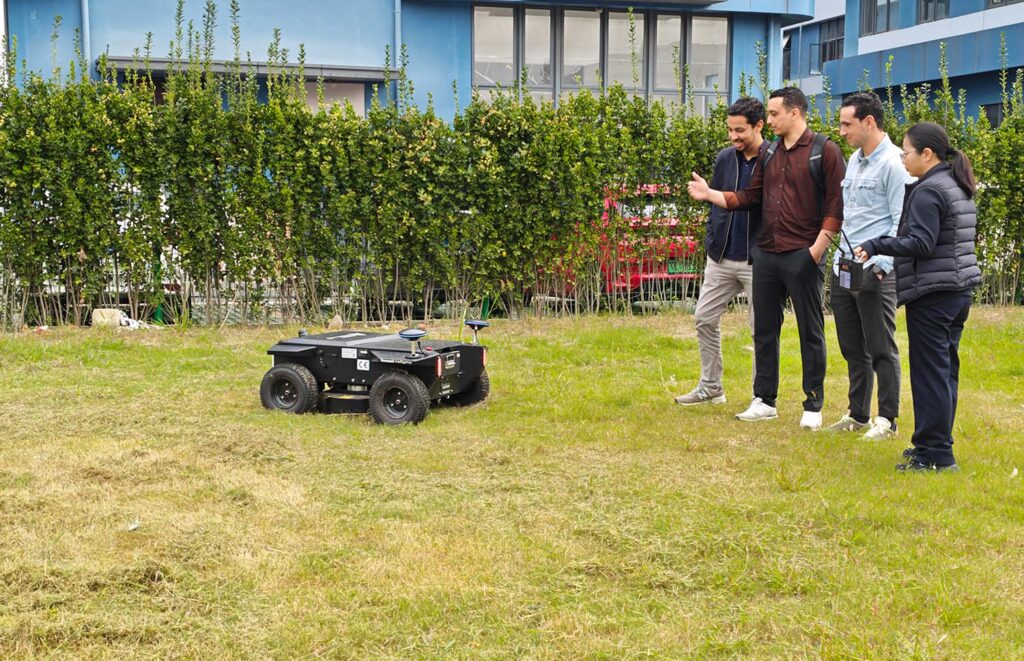
Recently, a customer from Brazil visited Suzhou Xinzuobiao Intelligent Equipment Co.,Ltd. The customer is engaged in the solar power industry and was particularly interested in smart mowing solutions for solar farms.
After discussing the customer’s requirements and the operating conditions of photovoltaic sites, we recommended the XuanNiao R1 wheeled, all-electric commercial smart mower.
Why did we recommend this model for solar farm vegetation management?
1. What Do Solar Farms Require from Mowing Equipment?
Unlike conventional lawns, solar farms have specific operating conditions.
Photovoltaic panels, mounting structures, cables, and other electrical facilities are distributed throughout the site. Mowing equipment must operate within designated areas and navigate access routes that may have limited space.
For solar farm operators, choosing the right mower involves several important considerations:
- Accessibility: Can the machine operate within the available pathways and site layout?
- Maneuverability: Can it turn and move efficiently in areas with limited operating space?
- Operating costs: Is its power system suitable for regular, long-term vegetation management?
- Automation: Can navigation technology support planned routes and autonomous mowing, reducing the need for continuous manual driving?
Based on these considerations, the XuanNiao R1 was selected as a suitable model for further discussion.
2. Why Recommend the XuanNiao R1 Electric Smart Mower?
2.1 Four-Wheel Drive for Flexible Operation
Solar farm layouts vary from project to project. Panel spacing, access routes, turning areas, and ground conditions all influence equipment selection.
The XuanNiao R1 features a four-wheel-drive design and a compact vehicle layout, offering flexible maneuverability for suitable mowing areas.
Compared with larger tracked machines, a wheeled mower can offer practical advantages in operating environments where access space and turning flexibility are important.
Its suitability should be assessed against the actual pathway width, turning space, ground conditions, and site layout.
2.2 All-Electric Drive and Flat-Blade Mowing Design
The XuanNiao R1 adopts an all-electric drive system and a flat-blade mowing design.
Compared with conventional fuel-powered mowers, an electric mower generally operates with lower noise and does not require fuel refilling. It also eliminates certain engine-related maintenance tasks, such as engine oil changes.
For solar farm operators who need to carry out regular vegetation management, energy consumption and routine maintenance are important factors when evaluating long-term operating costs.
Actual operating costs depend on several factors, including equipment investment, charging conditions, mowing area, operating frequency, and electricity prices.
2.3 Autonomous Navigation for Planned Mowing Routes
One of the key advantages of the XuanNiao R1 is its potential for integration with an autonomous navigation control system.
Solar farms generally have defined site boundaries and relatively organized panel layouts. For sites that meet the required operating conditions, an autonomous navigation system can be added and adapted to the mower.
By combining site mapping, mowing-area definition, and route planning, the machine can perform mowing tasks along predefined paths.
This approach can reduce the need for continuous manual driving and help improve the automation of repetitive maintenance operations.
Autonomous navigation requires appropriate system configuration and machine-level integration. Actual performance depends on satellite signal conditions, pathway accessibility, mapping accuracy, sensor configuration, and on-site safety management.
3. From Manual Mowing to Autonomous Operations
In the past, vegetation management at many solar farms relied heavily on manual labor. As solar installations grow in size, manual mowing can create challenges in workload, maintenance scheduling, and operational efficiency.
Mechanized mowing equipment helps reduce repetitive manual tasks. When integrated with autonomous navigation, it can further support planned mowing operations and move vegetation management toward a more automated workflow.
For solar farm operators, this is not simply a change in equipment. It also creates new possibilities for organizing routine maintenance.
However, solar projects differ in their site conditions. Equipment selection should take into account panel spacing, pathway width, ground slope, vegetation type, and total mowing area. No single machine configuration is suitable for every solar farm.
4. Supporting International Solar Farm Applications
The visit from our Brazilian customer provided another opportunity to understand the growing interest in mechanized and intelligent vegetation management in international solar markets.
Suzhou Xinzuobiao Intelligent Equipment Co.,Ltd focuses on intelligent navigation technology and smart mowing equipment. We work with customers to discuss equipment configurations and navigation solutions according to their specific applications.
The XuanNiao R1 wheeled electric smart mower is an option for commercial applications where maneuverability, all-electric operation, and autonomous navigation capabilities are important considerations.
For solar farm projects, the navigation system configuration and machine integration can be further evaluated based on actual site conditions and operational requirements.
Conclusion
Vegetation management may seem like a routine task in solar farm maintenance, but it involves several important considerations, including equipment accessibility, energy consumption, mowing efficiency, and long-term operating costs.
The transition from manual mowing to mechanized equipment, and further toward autonomous navigation, is creating new possibilities for solar farm maintenance.
The visit from our Brazilian customer was a valuable opportunity to exchange ideas about real-world application requirements. Suzhou Xinzuobiao Intelligent Equipment Co.,Ltd will continue to explore the application of smart mowing equipment and autonomous navigation technology across different markets and outdoor operating environments.
If you are looking for an all-electric smart mower or an autonomous mowing solution for your solar farm, contact Suzhou Xinzuobiao Intelligent Equipment Co.,Ltd to discuss your site conditions and equipment requirements.