
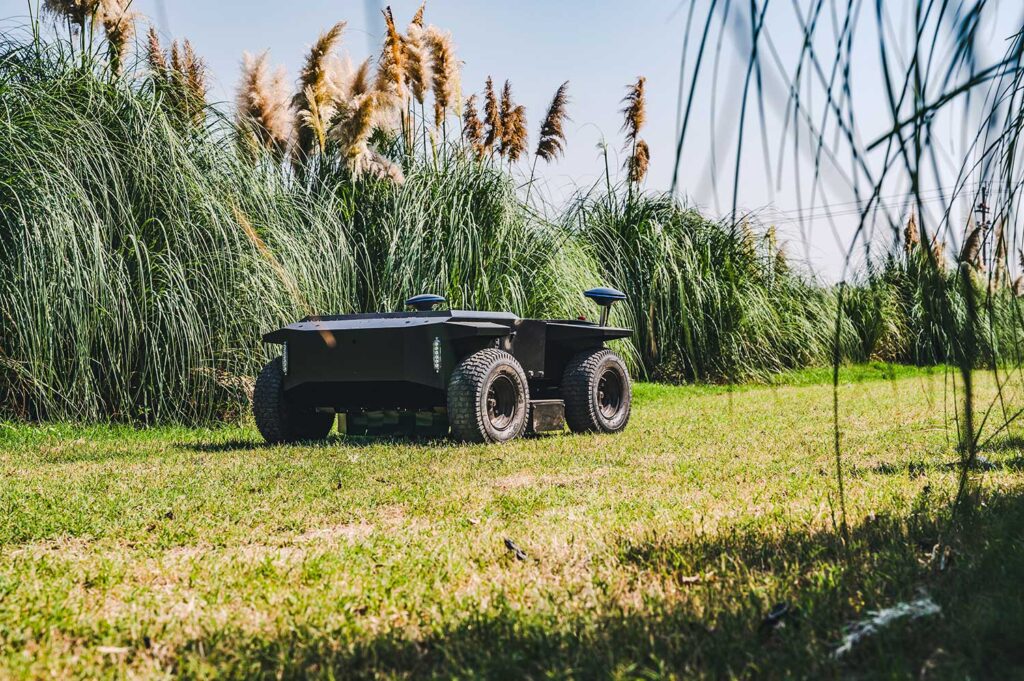
For large lawns, solar farms, agricultural land, orchards, and municipal slopes, a smart mower needs to do more than cut grass efficiently. It also needs a practical power management solution to support daily operations.
On large sites and projects with extended working hours, battery capacity alone is not enough. Charging time, battery replacement, and automatic recharging all play an important role in maintaining operational efficiency.
To address these requirements, Suzhou Xinzuobiao Intelligent Equipment Co.,Ltd offers smart mowing solutions with multiple power replenishment options, including onboard charging, interchangeable battery configurations, and charging-station-based automatic recharging.
These options allow customers to select a power solution according to their site size, working schedule, and automation requirements.
1. How Can Smart Mowers Address Battery Runtime Challenges?
Different mowing applications have different energy requirements.
For smaller areas, a machine may complete its scheduled task and recharge before the next operation. For large commercial projects, however, longer operating hours and shorter downtime are often more important.
A practical power solution should therefore consider not only battery capacity, but also charging methods, battery configurations, and task management.
Three charging and power management options can be considered for different applications.
2. Three Power Replenishment Options for Different Applications
2.1 Onboard Charging: Convenient Charging After Operation
The mower is equipped with an onboard charging port, allowing users to connect a charger directly after completing a mowing task without removing the battery.
For applicable product configurations, a full charge takes approximately two hours.
This option is suitable for sites where operating hours can be scheduled around charging periods.
Typical applications include:
- Small and medium-sized lawns
- Localized mowing areas on farms and orchards
- Outdoor sites with fixed charging locations
- Projects with planned daily charging schedules
Actual charging time depends on battery capacity, charger specifications, battery condition, and ambient temperature.
2.2 Dual-Battery Configuration: Reduce Downtime Through Battery Swapping
For large-area mowing projects, waiting for a single battery to recharge may limit operating efficiency.
A dual-battery configuration provides an alternative by allowing batteries to be used in rotation.
One battery powers the mower while the other is charged separately. When the operating battery needs to be replaced, users can switch batteries according to the machine’s design and operating procedures.
This arrangement can reduce charging-related downtime and provide greater flexibility for daily operations.
It is particularly suitable for:
- Large commercial lawns
- Solar farm vegetation management
- Agricultural and orchard applications
- Projects requiring extended equipment availability
Actual operating continuity depends on battery capacity, energy consumption, charging speed, and battery replacement time.
2.3 Automatic Recharging with a Charging Station
For projects requiring a higher level of automation, a charging-station configuration can provide additional convenience.
Depending on the machine and system configuration, the mower can be programmed to return to its charging area when a task is completed or when the battery reaches a preset low level.
With compatible navigation, charging-station, and task management functions, the equipment can support automatic docking, recharging, and resumption of scheduled mowing tasks.
For larger sites, multiple operating areas and charging locations can also be evaluated according to the project layout and system capabilities.
Typical applications include:
- Large commercial lawns
- Solar farm maintenance
- Multi-area landscaping projects
- Commercial sites seeking to reduce continuous manual operation
Automatic recharging and task resumption depend on the selected mower configuration, charging station, navigation system, and site conditions.
3. Choosing the Right Power Solution for Different Applications
Different sites have different operating areas, mowing schedules, and management requirements. The appropriate power solution should be selected accordingly.
3.1 Solar Farms: Long-Term Operation and Area Management
Solar farms often cover extensive areas and require regular vegetation management.
Depending on the site layout and equipment configuration, a dual-battery solution or charging-station-based automatic recharging system can be considered.
When combined with autonomous navigation, the mower can follow planned routes and carry out mowing tasks in designated areas.
3.2 Farms and Orchards: Flexible Power Management Across Different Areas
Agricultural land and orchards may contain multiple operating areas with different terrain and mowing requirements.
For projects with distributed mowing locations, onboard charging or interchangeable battery configurations can be considered according to actual operating conditions.
3.3 Municipal Slopes and Large Landscaping Projects: Operational Availability Matters
Municipal slopes and large landscaping areas often require scheduled maintenance over extensive outdoor spaces.
For applications with demanding operating schedules, dual-battery configurations and automatic recharging options are worth evaluating.
Equipment selection should also consider slope gradients, ground conditions, access routes, and site safety requirements.
4. Smart Mower Runtime Is More Than Battery Capacity
For commercial smart mowing equipment, runtime is a system-level consideration.
In addition to battery capacity, customers should evaluate:
- Charging efficiency: How long does the equipment need to recharge?
- Battery replacement: Are batteries easy to remove, replace, and rotate?
- Working conditions: How do grass type, grass height, and terrain affect energy consumption?
- Operation management: Does the machine need to return to a charging location automatically?
- Navigation and task management: Are multi-area planning, automatic recharging, and task resumption required?
- Site conditions: Are suitable charging locations and safe charging facilities available?
By considering the power system, battery configuration, charging method, and operating workflow together, customers can develop a more suitable power management solution for their projects.
Conclusion: More Flexible Power Solutions for Smart Mowing Operations
From direct onboard charging and dual-battery swapping to charging-station-based automatic recharging, smart mowing equipment can now support more flexible power management options.
Suzhou Xinzuobiao Intelligent Equipment Co.,Ltd provides smart mowing equipment and different power configuration options for outdoor applications, helping customers select solutions according to site size, working schedules, and automation requirements.
Whether the application involves solar farms, agricultural land, orchards, municipal green spaces, or large commercial lawns, the appropriate charging, battery swapping, and automatic recharging solution can be evaluated based on actual operating conditions.
Contact Suzhou Xinzuobiao Intelligent Equipment Co.,Ltd to learn more about our smart mowing equipment and discuss a suitable solution for your project.